As businesses seek to communicate more efficiently with their customers, A2P (Application-to-Person) text messaging has emerged as a critical communication channel. A2P messaging enables businesses to send automated messages to customers, such as appointment reminders, transaction notifications, and promotional messages, and engage with them in a more personalized way. However, choosing the right A2P text messaging provider can be a daunting task, with a wide range of providers offering different features, pricing, and reliability levels. In this guide, wel highlight the key factors to consider when choosing a provider, including features, reliability, security, scalability, cost, integration, support, compliance, and analytics.
Appointment reminders: Many businesses use A2P messaging to send appointment reminders to their customers. For example, a doctor’s office may send a reminder to a patient about their upcoming appointment, reducing the chances of no-shows and improving efficiency.
Transaction notifications: A2P messaging is also commonly used for transaction notifications, such as bank alerts, flight updates, or order confirmations. These messages keep customers informed about their transactions and can increase customer satisfaction.
Marketing and promotional messages: Businesses also use A2P messaging for marketing and promotional purposes. For example, retailers may send promotional offers to customers via text message, increasing sales and engagement.
Customer support: A2P messaging can also be used for customer support, enabling customers to communicate with businesses via text message. This channel can be particularly useful for quick and simple queries that don’t require a phone call or email.
Two-factor authentication: A2P messaging is also used for two-factor authentication (2FA) purposes, adding an extra layer of security to online accounts. Customers receive a verification code via text message, which they then enter into the online system to access their accounts.
What are the differences between A2P and P2P messaging?
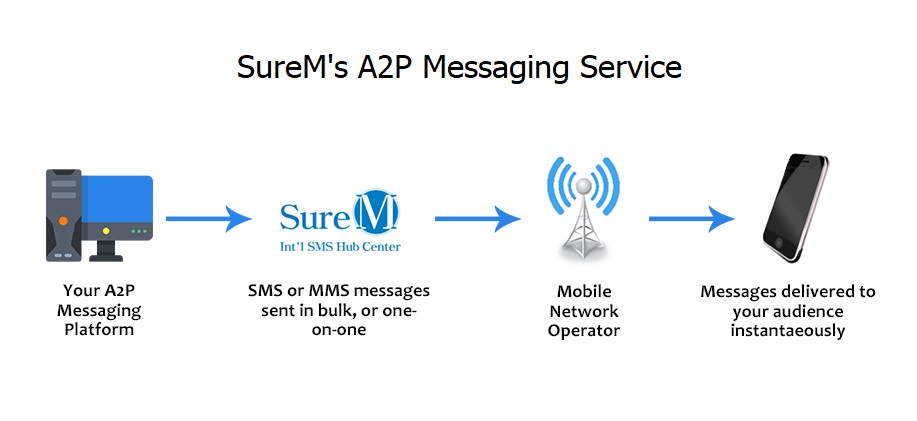
A2P (Application-to-Person) messaging and P2P (Person-to-Person) messaging are two distinct types of text messaging used for communication. P2P messaging is typically used for personal communication between individuals, while A2P messaging is used for commercial purposes such as marketing, customer support, and transaction notifications. A2P messaging is automated and typically involves large volumes of messages sent simultaneously to a large number of recipients, while P2P messaging is typically one-to-one conversations between individuals. A2P messaging is subject to more stringent regulations than P2P messaging, and A2P messages typically have a higher delivery rate due to specialized messaging platforms designed for high-volume messaging.
What are the types of A2P Messaging?
Marketing and promotional messages:
One of the most common uses of A2P messaging is for marketing and promotional messages. Businesses can send targeted messages to customers, such as promotional offers, product updates, or special discounts, increasing engagement and sales.
Transactional messages:
A2P messaging is also used for transactional messages, such as bank alerts, flight updates, or order confirmations. These messages keep customers informed about their transactions and can increase customer satisfaction.
Appointment reminders:
A2P messaging is commonly used to send appointment reminders to customers, such as patients, clients, or customers. These messages reduce the chances of no-shows and improve efficiency.
Customer support:
A2P messaging is also used for customer support purposes. Customers can communicate with businesses via text message, enabling quick and simple queries that don’t require a phone call or email.
Two-factor authentication:
A2P messaging is used for two-factor authentication (2FA) purposes, adding an extra layer of security to online accounts. Customers receive a verification code via text message, which they then enter into the online system to access their accounts.
Alerts and notifications:
A2P messaging is used to send alerts and notifications to customers, such as weather alerts, emergency notifications, or service disruptions. These messages keep customers informed about important events and updates.
What is a conversational message?
Conversational messaging is a type of A2P (Application-to-Person) messaging that enables businesses to engage with their customers in a more personalized and interactive way. Rather than sending one-way promotional messages, conversational messaging allows for two-way communication between businesses and customers via text message.
With conversational messaging, businesses can provide a more human-like experience, making it easier for customers to ask questions, get support, and receive recommendations. Conversational messaging can be used for a variety of purposes, such as customer service, sales, and support, depending on the business’s needs.
One of the main advantages of conversational messaging is its convenience. Customers can communicate with businesses at any time, from anywhere, and get quick and easy answers to their questions. This makes it easier for businesses to provide a better customer experience, increasing customer satisfaction and loyalty.
Another advantage of conversational messaging is its scalability. Businesses can use chatbots or automated systems to handle large volumes of messages, reducing the need for human intervention and enabling more efficient communication. This can be particularly useful for businesses with limited resources or those that receive a high volume of customer inquiries.
Informational messaging
Informational messaging is a type of A2P (Application-to-Person) messaging that delivers important information to customers in a timely and efficient manner. It typically involves sending automated messages to a large number of recipients simultaneously, making it an effective way for businesses to reach their customers at scale.
Informational messaging can be used for a variety of purposes, such as emergency alerts, service notifications, and public information announcements. For example, businesses can use informational messaging to inform customers of a change in store hours, a service outage, or a weather-related emergency.
One of the key advantages of informational messaging is its speed and efficiency. Businesses can send messages to large groups of customers instantly, reducing the time and resources required to deliver important information. This can be particularly useful in emergency situations, where quick and effective communication is critical.
Another advantage of informational messaging is its reach. Businesses can send messages to customers regardless of their location, ensuring that important information is delivered to everyone who needs it. This can be particularly useful for businesses with a large and dispersed customer base, such as national or global companies.
Promotional Messaging
Promotional messaging is a type of A2P (Application-to-Person) messaging that is used by businesses to promote their products or services to customers. It typically involves sending targeted and personalized messages to a large number of recipients simultaneously, making it an effective way for businesses to reach their customers at scale.
Promotional messaging can be used for a variety of purposes, such as product launches, special offers, and seasonal promotions. For example, businesses can use promotional messaging to offer discounts on products, announce new products or services, or promote events and sales.
One of the key advantages of promotional messaging is its ability to drive sales and revenue. By offering discounts or promotions, businesses can incentivize customers to make purchases, increasing their overall revenue and profitability. Additionally, promotional messaging can help businesses build brand awareness and create stronger relationships with their customers, which can lead to increased loyalty and repeat business over time.
Another advantage of promotional messaging is its targeting and personalization capabilities. Businesses can use customer data to send targeted messages to specific segments of their customer base, ensuring that the message is relevant and valuable to the recipient. This can increase the effectiveness of promotional messaging and improve customer engagement and response rates.
Benefits of A2P Messaging
A2P messaging enables businesses to send messages at scale, quickly and efficiently, to customers regardless of their location. It allows businesses to target specific segments of their customer base with personalized messaging, increasing the relevance and effectiveness of their communications. A2P messaging is also cost-effective, making it an affordable option for businesses of all sizes. By using A2P messaging, businesses can improve customer engagement and satisfaction, ultimately driving sales and revenue over time. Overall, A2P messaging provides businesses with a powerful tool for customer communication that can help them build stronger relationships with their customers and stay ahead of the competition.
Here an example of how A2P messages were used in real life.
During the COVID-19 pandemic, the Singapore government used A2P messaging to send important updates and information about the virus to the public. The government partnered with local mobile network operators to send SMS messages to residents, providing information about measures being taken to prevent the spread of the virus, as well as updates on the number of cases and deaths in the country.
The messages were sent in multiple languages, ensuring that all residents had access to important information, regardless of their native language. The government also used A2P messaging to send alerts to residents in areas where there were confirmed cases of the virus, advising them to take extra precautions and get tested if they were experiencing symptoms.
The use of A2P messaging allowed the Singapore government to quickly and effectively disseminate important information to the public during a time of crisis. The personalized and targeted approach ensured that residents received relevant and timely information, improving their overall safety and well-being.
By using A2P messaging, businesses can improve their communication with customers, leading to increased customer satisfaction and loyalty. The personalized and targeted approach ensures that customers receive relevant and valuable information, while the efficiency of the messaging system saves time and resources for businesses.
As businesses continue to adopt digital channels for customer communication, A2P messaging will become increasingly important. With its scalability, targeting capabilities, and personalization options, A2P messaging enables businesses to communicate with their customers in a way that is convenient, efficient, and effective. By leveraging the power of A2P messaging, businesses can stay ahead of the competition and build strong relationships with their customers over time.
SureM is a leading provider of A2P (Application-to-Person) messaging services, offering businesses a reliable and effective way to communicate with their customers. Our platform provides businesses with a scalable, secure, and user-friendly interface that enables them to send personalized messages to their customers quickly and efficiently. Our advanced targeting and personalization capabilities allow businesses to send messages that are relevant and valuable to each individual customer, improving engagement and driving sales. With our industry-leading expertise and customer support, SureM is dedicated to providing businesses with a top-tier A2P messaging service that meets their unique needs and requirements. Partnering with SureM allows businesses to take advantage of the many benefits of A2P messaging and stay ahead of the competition.
#GlobalSMS #SMSMarketing #BusinessCommunication #MobileMarketing #TextMarketing #MarketingSolutions #SMSBusiness #TextMessaging #SMSGlobal #MobileBusiness #BusinessSMS
Here are the most common use cases:
Appointment reminders: Many businesses use A2P messaging to send appointment reminders to their customers. For example, a doctor’s office may send a reminder to a patient about their upcoming appointment, reducing the chances of no-shows and improving efficiency.
Transaction notifications: A2P messaging is also commonly used for transaction notifications, such as bank alerts, flight updates, or order confirmations. These messages keep customers informed about their transactions and can increase customer satisfaction.
Marketing and promotional messages: Businesses also use A2P messaging for marketing and promotional purposes. For example, retailers may send promotional offers to customers via text message, increasing sales and engagement.
Customer support: A2P messaging can also be used for customer support, enabling customers to communicate with businesses via text message. This channel can be particularly useful for quick and simple queries that don’t require a phone call or email.
Two-factor authentication: A2P messaging is also used for two-factor authentication (2FA) purposes, adding an extra layer of security to online accounts. Customers receive a verification code via text message, which they then enter into the online system to access their accounts.
What are the differences between A2P and P2P messaging?
A2P (Application-to-Person) messaging and P2P (Person-to-Person) messaging are two distinct types of text messaging used for communication. P2P messaging is typically used for personal communication between individuals, while A2P messaging is used for commercial purposes such as marketing, customer support, and transaction notifications. A2P messaging is automated and typically involves large volumes of messages sent simultaneously to a large number of recipients, while P2P messaging is typically one-to-one conversations between individuals. A2P messaging is subject to more stringent regulations than P2P messaging, and A2P messages typically have a higher delivery rate due to specialized messaging platforms designed for high-volume messaging.
What are the types of A2P Messaging?
Marketing and promotional messages:
One of the most common uses of A2P messaging is for marketing and promotional messages. Businesses can send targeted messages to customers, such as promotional offers, product updates, or special discounts, increasing engagement and sales.
Transactional messages:
A2P messaging is also used for transactional messages, such as bank alerts, flight updates, or order confirmations. These messages keep customers informed about their transactions and can increase customer satisfaction.
Appointment reminders:
A2P messaging is commonly used to send appointment reminders to customers, such as patients, clients, or customers. These messages reduce the chances of no-shows and improve efficiency.
Customer support:
A2P messaging is also used for customer support purposes. Customers can communicate with businesses via text message, enabling quick and simple queries that don’t require a phone call or email.
Two-factor authentication:
A2P messaging is used for two-factor authentication (2FA) purposes, adding an extra layer of security to online accounts. Customers receive a verification code via text message, which they then enter into the online system to access their accounts.
Alerts and notifications:
A2P messaging is used to send alerts and notifications to customers, such as weather alerts, emergency notifications, or service disruptions. These messages keep customers informed about important events and updates.
What is a conversational message?
Conversational messaging is a type of A2P (Application-to-Person) messaging that enables businesses to engage with their customers in a more personalized and interactive way. Rather than sending one-way promotional messages, conversational messaging allows for two-way communication between businesses and customers via text message.
With conversational messaging, businesses can provide a more human-like experience, making it easier for customers to ask questions, get support, and receive recommendations. Conversational messaging can be used for a variety of purposes, such as customer service, sales, and support, depending on the business’s needs.
One of the main advantages of conversational messaging is its convenience. Customers can communicate with businesses at any time, from anywhere, and get quick and easy answers to their questions. This makes it easier for businesses to provide a better customer experience, increasing customer satisfaction and loyalty.
Another advantage of conversational messaging is its scalability. Businesses can use chatbots or automated systems to handle large volumes of messages, reducing the need for human intervention and enabling more efficient communication. This can be particularly useful for businesses with limited resources or those that receive a high volume of customer inquiries.
Informational messaging
Informational messaging is a type of A2P (Application-to-Person) messaging that delivers important information to customers in a timely and efficient manner. It typically involves sending automated messages to a large number of recipients simultaneously, making it an effective way for businesses to reach their customers at scale.
Informational messaging can be used for a variety of purposes, such as emergency alerts, service notifications, and public information announcements. For example, businesses can use informational messaging to inform customers of a change in store hours, a service outage, or a weather-related emergency.
One of the key advantages of informational messaging is its speed and efficiency. Businesses can send messages to large groups of customers instantly, reducing the time and resources required to deliver important information. This can be particularly useful in emergency situations, where quick and effective communication is critical.
Another advantage of informational messaging is its reach. Businesses can send messages to customers regardless of their location, ensuring that important information is delivered to everyone who needs it. This can be particularly useful for businesses with a large and dispersed customer base, such as national or global companies.
Promotional Messaging
Promotional messaging is a type of A2P (Application-to-Person) messaging that is used by businesses to promote their products or services to customers. It typically involves sending targeted and personalized messages to a large number of recipients simultaneously, making it an effective way for businesses to reach their customers at scale.
Promotional messaging can be used for a variety of purposes, such as product launches, special offers, and seasonal promotions. For example, businesses can use promotional messaging to offer discounts on products, announce new products or services, or promote events and sales.
One of the key advantages of promotional messaging is its ability to drive sales and revenue. By offering discounts or promotions, businesses can incentivize customers to make purchases, increasing their overall revenue and profitability. Additionally, promotional messaging can help businesses build brand awareness and create stronger relationships with their customers, which can lead to increased loyalty and repeat business over time.
Another advantage of promotional messaging is its targeting and personalization capabilities. Businesses can use customer data to send targeted messages to specific segments of their customer base, ensuring that the message is relevant and valuable to the recipient. This can increase the effectiveness of promotional messaging and improve customer engagement and response rates.
Benefits of A2P Messaging
A2P messaging enables businesses to send messages at scale, quickly and efficiently, to customers regardless of their location. It allows businesses to target specific segments of their customer base with personalized messaging, increasing the relevance and effectiveness of their communications. A2P messaging is also cost-effective, making it an affordable option for businesses of all sizes. By using A2P messaging, businesses can improve customer engagement and satisfaction, ultimately driving sales and revenue over time. Overall, A2P messaging provides businesses with a powerful tool for customer communication that can help them build stronger relationships with their customers and stay ahead of the competition.
Here an example of how A2P messages were used in real life.
During the COVID-19 pandemic, the Singapore government used A2P messaging to send important updates and information about the virus to the public. The government partnered with local mobile network operators to send SMS messages to residents, providing information about measures being taken to prevent the spread of the virus, as well as updates on the number of cases and deaths in the country.
The messages were sent in multiple languages, ensuring that all residents had access to important information, regardless of their native language. The government also used A2P messaging to send alerts to residents in areas where there were confirmed cases of the virus, advising them to take extra precautions and get tested if they were experiencing symptoms.
The use of A2P messaging allowed the Singapore government to quickly and effectively disseminate important information to the public during a time of crisis. The personalized and targeted approach ensured that residents received relevant and timely information, improving their overall safety and well-being.
By using A2P messaging, businesses can improve their communication with customers, leading to increased customer satisfaction and loyalty. The personalized and targeted approach ensures that customers receive relevant and valuable information, while the efficiency of the messaging system saves time and resources for businesses.
As businesses continue to adopt digital channels for customer communication, A2P messaging will become increasingly important. With its scalability, targeting capabilities, and personalization options, A2P messaging enables businesses to communicate with their customers in a way that is convenient, efficient, and effective. By leveraging the power of A2P messaging, businesses can stay ahead of the competition and build strong relationships with their customers over time.
SureM is a leading provider of A2P (Application-to-Person) messaging services, offering businesses a reliable and effective way to communicate with their customers. Our platform provides businesses with a scalable, secure, and user-friendly interface that enables them to send personalized messages to their customers quickly and efficiently. Our advanced targeting and personalization capabilities allow businesses to send messages that are relevant and valuable to each individual customer, improving engagement and driving sales. With our industry-leading expertise and customer support, SureM is dedicated to providing businesses with a top-tier A2P messaging service that meets their unique needs and requirements. Partnering with SureM allows businesses to take advantage of the many benefits of A2P messaging and stay ahead of the competition.
For furthere inquiries, please contact suremaster@surem.com
#GlobalSMS #SMSMarketing #BusinessCommunication #MobileMarketing #TextMarketing #MarketingSolutions #SMSBusiness #TextMessaging #SMSGlobal #MobileBusiness #BusinessSMS